If you've been Googling who can help with your business data, you've probably come across three different titles, data analyst, BI consultant, data scientist, and wondered what the difference is. From the outside, they all sound like the same thing. They're not. And hiring or outsourcing the wrong one wastes time, money, and a lot of goodwill.
Here's the plain-English breakdown. No jargon.
Data scientist
Probably not what you need yetA data scientist builds predictive models using machine learning, statistical algorithms, and large, complex datasets. They're the people building AI, recommendation engines, and fraud detection systems. The work is deeply mathematical and requires significant data infrastructure to be useful. If you're a manufacturing or engineering business trying to understand your monthly sales and margins, this is not where you start. You'd be paying top-tier salaries for someone doing work that doesn't match your problem.
BI consultant
Sometimes right, depends on what you actually needA BI (Business Intelligence) consultant is typically tool-focused, they implement and configure BI platforms like Power BI, Tableau, or Qlik. They're strong at building dashboards and reporting infrastructure. Where they can fall short is on the analytical side: connecting the dashboards to your actual business questions, interpreting what the numbers mean, and making recommendations based on what they find. They'll build you a beautiful dashboard. Whether it answers the right questions is a different matter.
Data analyst
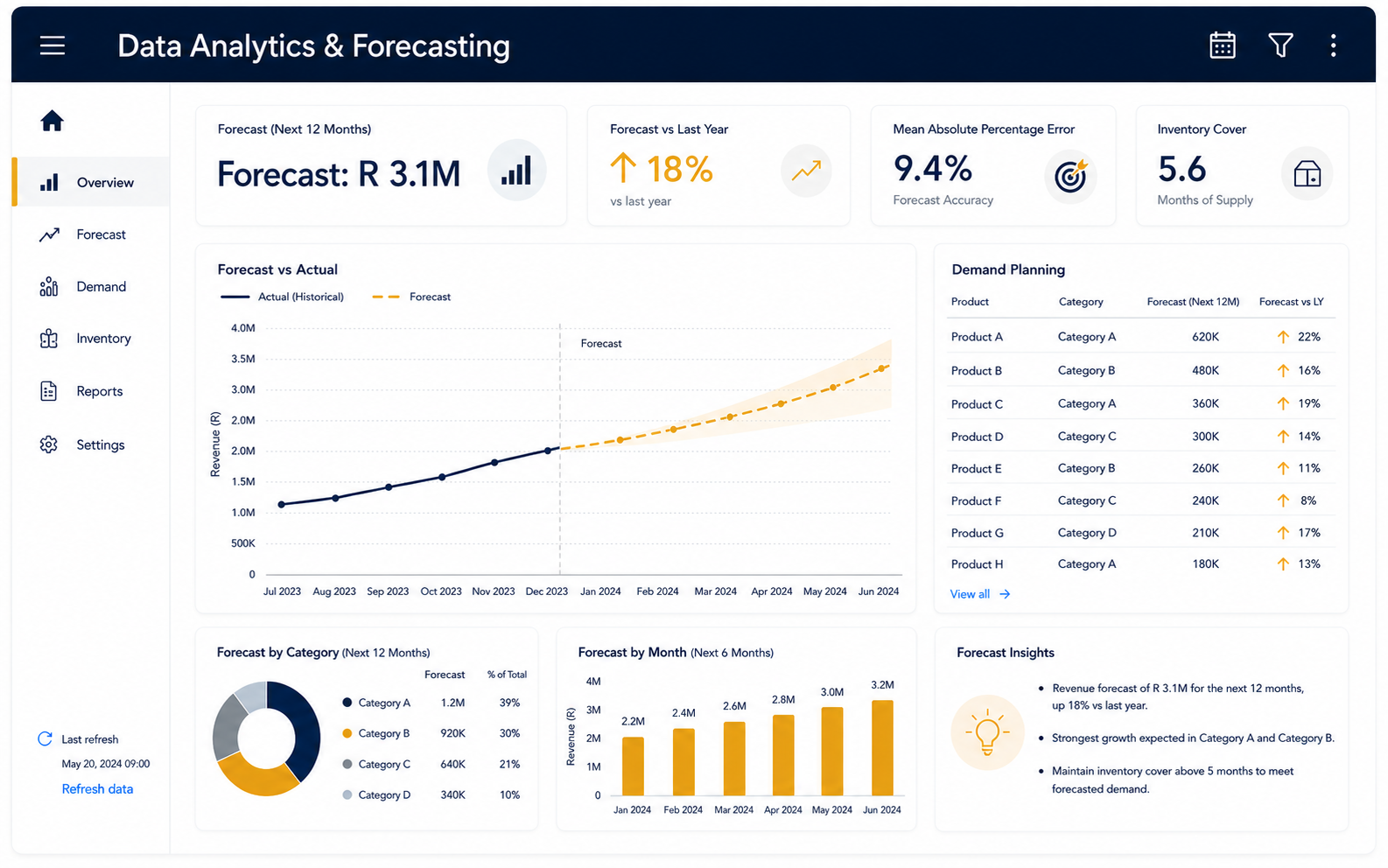
Usually the right starting pointA data analyst works with your business data to answer your business questions. They find patterns, identify anomalies, build reports, and translate numbers into insight. A good data analyst understands both the tools (Power BI, SQL, Excel, Python) and the business context, which is why they're valuable. They don't just build dashboards; they tell you what the dashboard is showing and what it means for your decisions.
What most manufacturing and engineering businesses actually need
If you're an owner-managed manufacturing or engineering firm in Gauteng, with decent historical data, a need for clear reporting, and decisions to make about stock, production, sales, and margin, what you need is data analytics. Not data science. Not just a BI tool implementation.
You need someone who can:
- Connect to your existing data (ERP, invoicing, production system, spreadsheets)
- Clean it, structure it, and make it reliable
- Build dashboards that show you the numbers you actually need
- Help you understand what those numbers mean for your business decisions
- Come back every month to update the dashboards and answer your questions
That's an outsourced data analytics function, not a once-off tool implementation, and not a data science project.
Why you probably don't need to hire any of them full-time
Most owner-managed manufacturing and engineering businesses don't generate enough analytical work to justify a full-time data hire of any kind. What you need is regular, recurring support, monthly dashboards, quarterly analysis, occasional deep-dives, not someone sitting at a desk full-time doing half-tasks.
A fractional or outsourced data analyst gives you the capability without the overhead. You get the analytical work done, on a retainer, at a fraction of the cost of a full-time salary, and the work belongs to you.
5 questions to help you decide what you actually need
- Do you need dashboards and reports, or AI models and predictions? (Dashboard = data analyst. AI models = data scientist.)
- Do you have questions about your current business data, or do you need to build entirely new data infrastructure? (Questions = analyst. Infrastructure = BI consultant.)
- Is your data relatively accessible (spreadsheets, basic ERP, invoicing system), or is it large, complex, and unstructured? (Accessible = analyst. Complex + large = data scientist territory.)
- Do you need someone ongoing, or is this a once-off project? (Ongoing = retainer model. Once-off = project-based consulting.)
- Do you know roughly what questions you want answered? (Yes = analyst. No idea yet = start with a discovery conversation first.)