Most manufacturing business owners in Gauteng don't do demand forecasting. They run on gut feel, last year's numbers, or a sales rep's optimism about next quarter. And it mostly works, until it doesn't. Until you're sitting on three months of excess stock you can't move, or you've turned down an order because your production capacity was already full from work that didn't materialise.
Demand forecasting isn't complicated. It's not a crystal ball. It's a systematic way of using the data you already have to make better predictions about what demand will look like, so you can plan your stock, production, and cash flow before the month arrives, not after.
What demand forecasting actually means
At its simplest, demand forecasting is using your historical sales data to predict future demand, by product, by customer, by region, or by any combination that's meaningful to your business. It takes patterns in your past and projects them forward, adjusting for seasonality, trends, and any known upcoming changes (a new contract, a market shift, a product launch).
For a manufacturing business, a useful forecast tells you:
- What volumes you're likely to produce and sell next month, next quarter, next year
- How much raw material and stock you'll need, and when to order it
- Whether your current production capacity can handle expected demand
- Where cash pressure is likely to come from, and when
Why manufacturers need it more than most
Manufacturers sit at the intersection of everything that makes forecasting valuable. You have lead times to manage, if you order raw material the week you need it, you're already too late. You have production schedules to plan, you can't spin up capacity overnight. You have cash tied up in stock, too much inventory kills your cash flow; too little kills your orders.
Most service businesses can scale up and down relatively quickly. Manufacturers can't. Your planning horizon is longer. Which means your need to see what's coming is also greater, and your cost of getting it wrong is higher.
The reality in most Gauteng manufacturing firms
What we typically see when we start working with a new client is one of these three situations:
- Gut feel: "We've been in this industry for 15 years. I know roughly what's coming." This works until it doesn't. One big order that doesn't materialise, one supply disruption, and the gut feel costs you.
- Last year's numbers: The budget for next year is last year +/- 10%, and the production plan follows the same logic. No pattern analysis. No seasonality adjustment. No account for what changed in the market.
- Sales team's wishlist: The forecast is whatever the sales team says they're going to close. Which tends to be optimistic. Very optimistic.
None of these is a forecast. They're guesses with different levels of confidence attached to them.
What you need to get started
The good news is that most manufacturing businesses already have the data they need. If you have 12–24 months of order or sales history, you can build a useful forecast. You don't need a sophisticated system. You need someone to pull the data, clean it, identify the patterns, and build a model that updates monthly as new numbers come in.
The minimum you need:
- Sales or order history by product line and customer, ideally at monthly granularity
- Some understanding of your known seasonal patterns or business cycles
- A way to flag exceptions, one-off large orders, contract changes, market disruptions, so they don't distort the model
Most of this already exists in your invoicing system, your ERP, or yes, your spreadsheets. The work is in structuring it and building the model on top of it.
What a working forecast looks like in practice
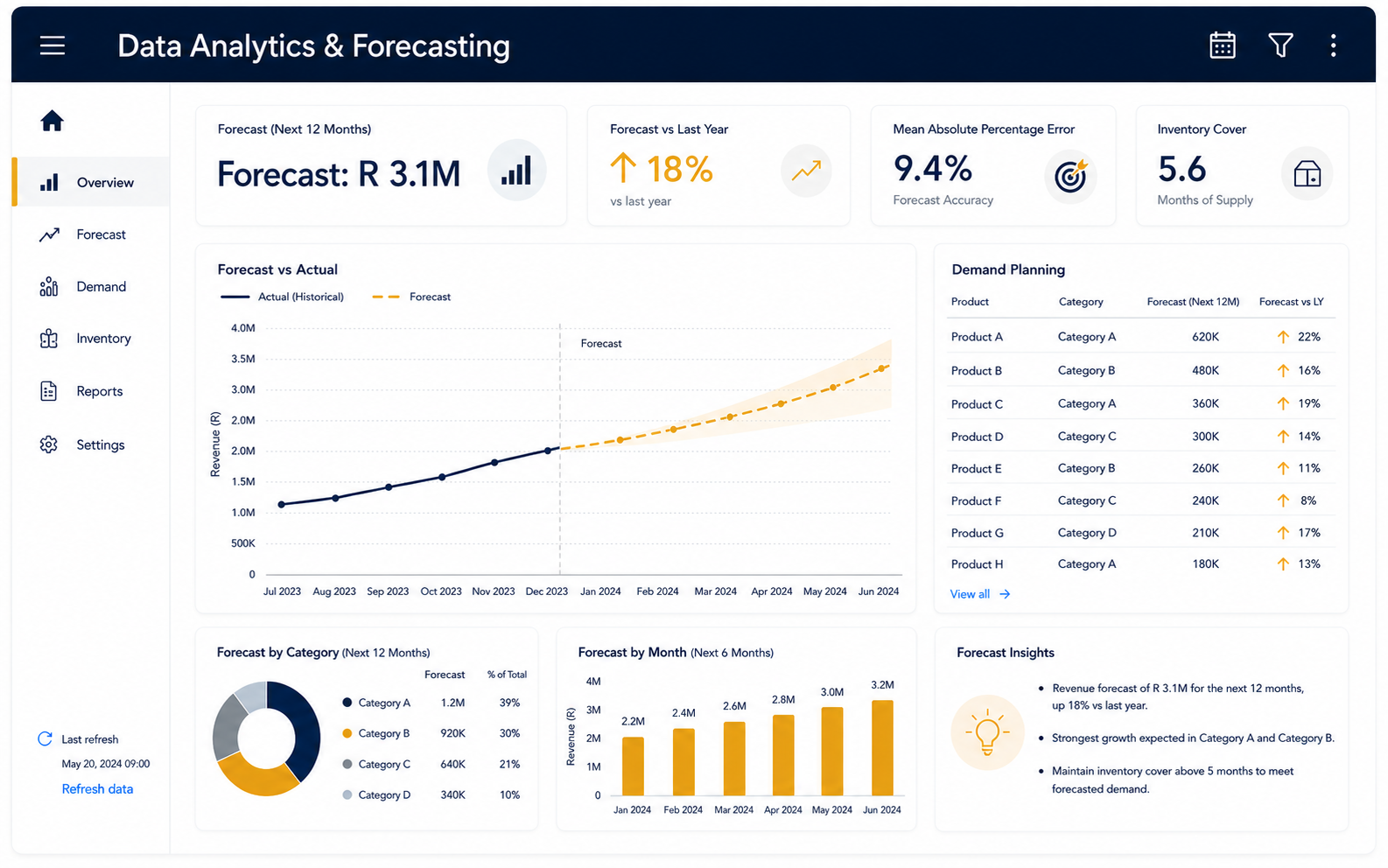
A good demand forecast for a manufacturing business isn't a single number. It's a range with a most-likely scenario and upper and lower bounds. It gets refreshed monthly as new actuals come in. It feeds directly into your stock ordering, production scheduling, and cash flow planning.
In Power BI, you can visualise this as a rolling 12-month forward projection alongside your actuals, so every month you can see how your forecast compared to reality and adjust the model accordingly. Over time, the forecast gets more accurate as it learns the patterns in your specific business.
The goal isn't perfection. It's directional accuracy, knowing whether demand is trending up or down, spotting a slow quarter early enough to act, and making production and purchasing decisions on something better than gut feel.