This is a story about a manufacturing business in Gauteng that came to us with a problem that sounded simple: "We spend too much time on reports and we never trust the numbers." By the time we'd finished our first proper look at their data, we'd found something that changed a major commercial relationship and improved their overall margin by several percentage points.
Here's how it unfolded.
The situation when we started
The business is an owner-managed manufacturer supplying engineered components to a handful of large industrial clients across Gauteng. They'd been trading for 12 years. Solid reputation. Consistent revenue. But the internal reporting situation was painful.
Every month, two people spent the better part of three working days pulling sales data from their invoicing system, stock levels from a separate system, and production output from, yes, a set of spreadsheets that had been built by someone who'd long since left the company. The three-day process produced a PDF management report that went to the owner and was usually two to three weeks out of date by the time anyone read it.
The owner's own words: "I never fully trust the numbers. I just accept them and move on."
What we built
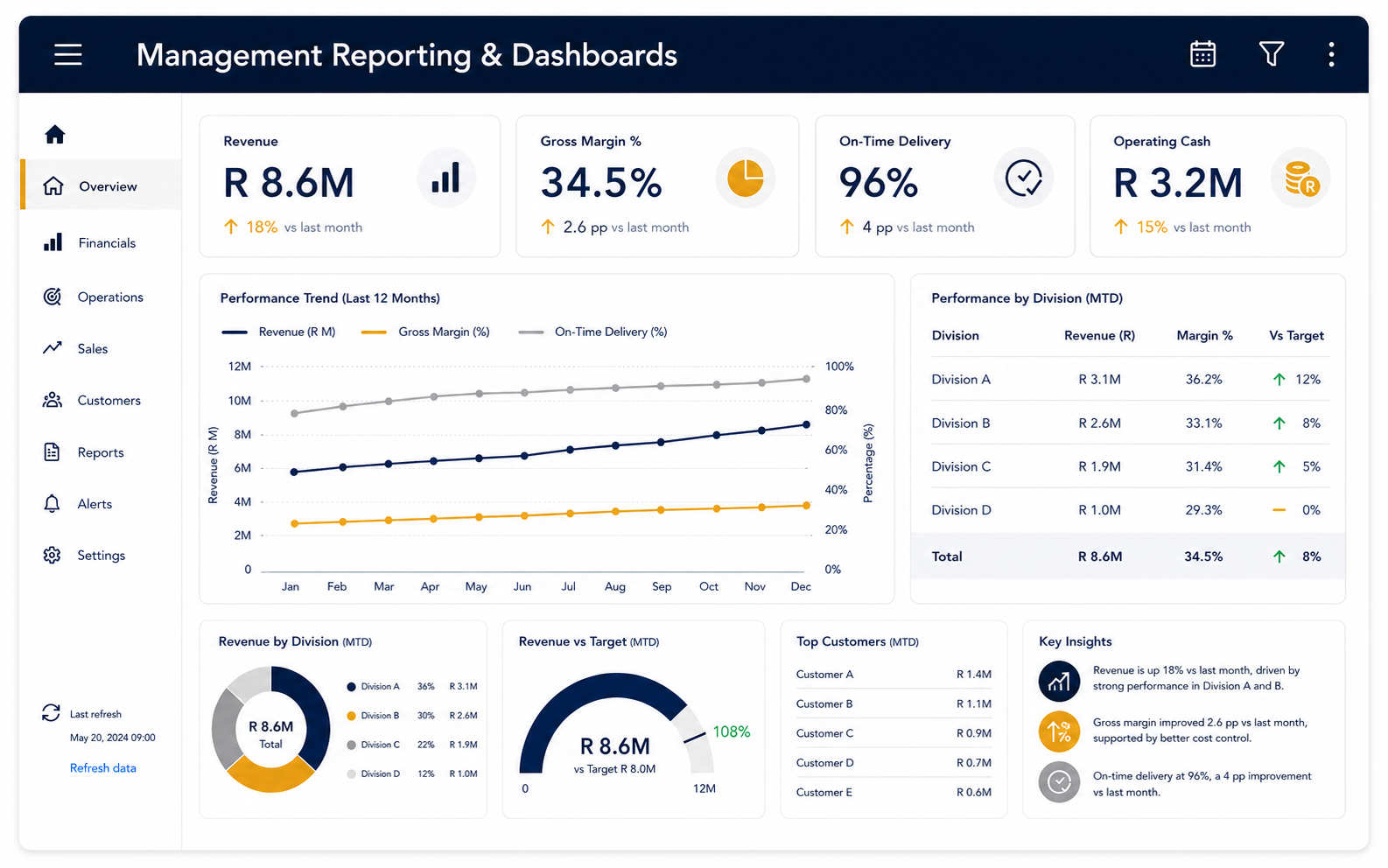
We connected Power BI directly to their invoicing and stock systems, and built structured data extracts from the production spreadsheets to supplement it. Within four weeks, we had a live management dashboard showing:
- Revenue and margin by product line, updated daily from the invoicing data
- Stock levels and inventory days by SKU
- Production output vs target by week
- Revenue and margin per customer, ranked by actual profitability (not volume)
- Rolling 12-month revenue trend
The report that took three days to build now updates overnight. The owner opens it every Monday morning and is looking at current data, not last month's.
What the data showed them
The first month of live reporting produced three findings that the owner hadn't seen before.
Finding 1: Two product lines were margin negative
Two categories that appeared in the revenue figures as solid performers turned out, when direct costs were properly allocated, to be generating a gross margin of under 3%, effectively breakeven, once you account for the production overhead attached to them. Both had been priced years earlier and never reviewed.
Finding 2: One customer was responsible for 58% of actual profit
The revenue split across the top four customers looked balanced, roughly 25% each. But when margin was layered in, one customer, who placed consistent, predictable, standard orders and never pushed for discounts, was generating 58% of the business's total gross profit. The other three were noisy, demanding, and much less profitable per rand of revenue.
Finding 3: Stock turnover on one component was 180+ days
One raw material component had been sitting in the warehouse for an average of 183 days before being consumed. That's six months of cash tied up in stock. The reason was a minimum order quantity that had been set years ago and never revisited after demand patterns changed.
What changed
The owner had a pricing conversation with the two underperforming product lines and got them to viable margins. He restructured the account management approach with the most profitable customer, more face time, faster turnaround, treated as a priority account. He renegotiated the minimum order quantity on the slow-moving component and freed up meaningful working capital.
None of these were complicated actions. What made them possible was simply having the numbers clearly in front of him, not buried in a PDF that was already two weeks old.
The management report now takes one person 20 minutes to review each month, not three days to compile. And the owner trusts the numbers.
What the ongoing retainer looks like
We work with this business on a monthly retainer. Every month we update the dashboard, run a short review of anything that's moved materially, and answer any ad hoc data questions that came up in the month. It's a small, consistent commitment, and the visibility it provides is now built into how the owner runs the business.
Details in this case study have been anonymised and some figures are composites to protect client confidentiality. The patterns and findings are representative of real engagements.