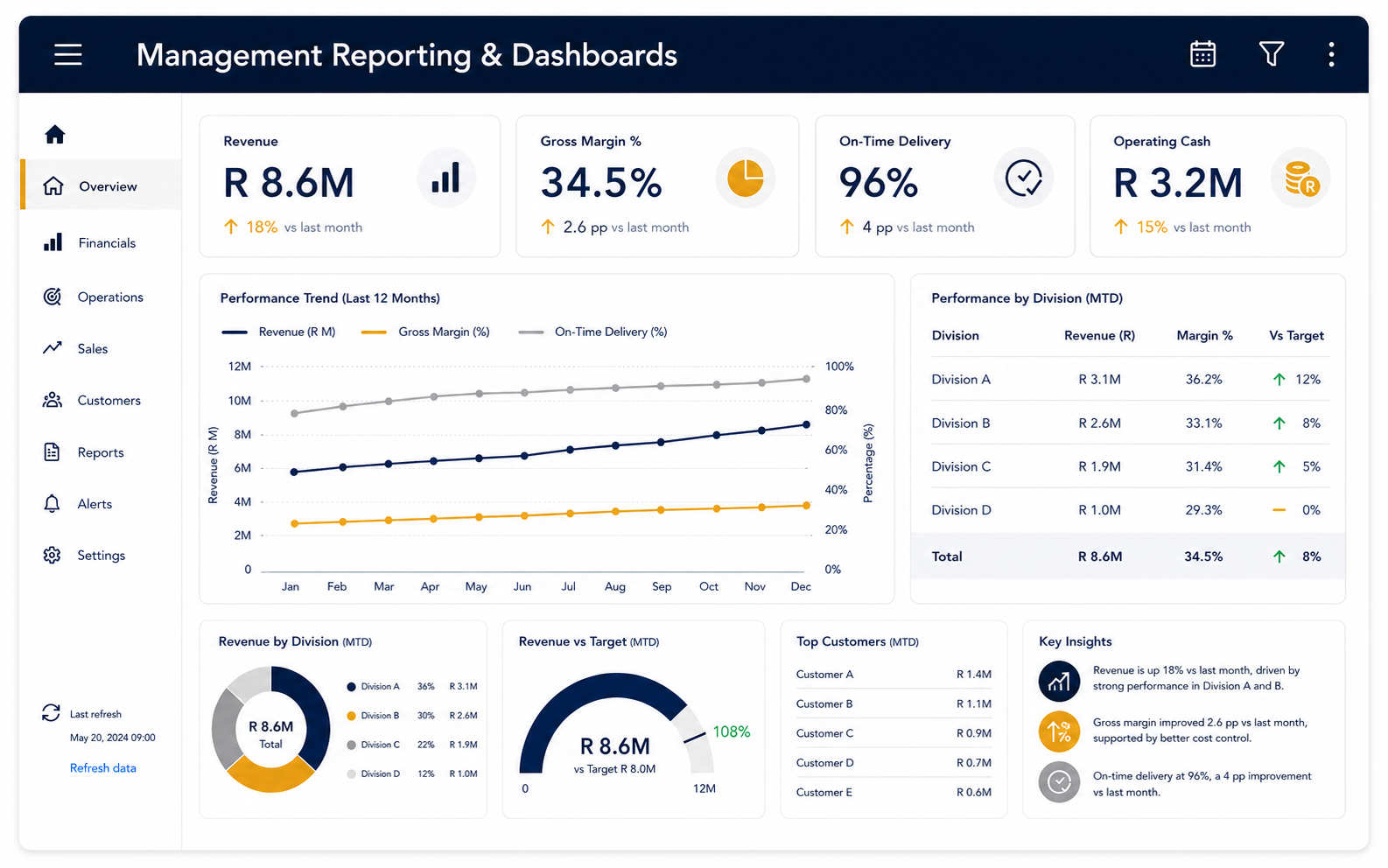
Most manufacturing business owners track one number: revenue. Revenue is up, the month was good. Revenue is down, the month was bad. But revenue doesn't tell you whether the month was actually profitable. It doesn't tell you which products made money and which bled margin. It doesn't tell you whether your sales pipeline is healthy or whether next month is going to hurt.
Here are the 7 numbers you should be seeing every month, and what each one tells you that revenue alone never will.
KPI 1
Gross margin per product line
Revenue is vanity. Gross margin is reality. You need to know, per product category, what percentage of each rand of revenue ends up as profit after direct costs. If you're not tracking this, you probably have at least one product line that's dragging your overall margin down and you don't know it. This number alone changes pricing conversations, production priority decisions, and what you sell hard vs what you quietly phase out.
KPI 2
On-time delivery rate
What percentage of orders shipped on the date the customer expected? If this number is below 90%, you have a production planning or capacity problem that's actively costing you customer relationships. Most manufacturers know when deliveries are late, but very few track the trend over time. One bad month is noise. Six bad months is a pattern that needs fixing.
KPI 3
Stock turnover and inventory days
How many days does your stock sit before it's used or sold? High inventory days means cash tied up on your shelves. Low inventory days means you're running lean, which is good unless it's tipping into stock-outs. This number should be tracked by product category, because what's acceptable for a fast-moving consumable is different from a slow-moving specialty component.
KPI 4
Revenue and margin per customer
Your biggest customer by revenue isn't necessarily your most profitable customer. Some customers are expensive to serve, they require custom orders, frequent small deliveries, intense account management, or constant price negotiations. Knowing margin per customer (not just revenue per customer) tells you where to focus your sales effort and which accounts are worth fighting for at contract renewal time.
KPI 5
Sales pipeline value and conversion rate
How much is in your pipeline right now, and what percentage of your quotes typically convert to orders? These two numbers together tell you what next month's revenue is likely to look like. Without them, you're always reacting. With them, you can see a slow month coming 6–8 weeks before it arrives, which is enough time to act.
KPI 6
Production output vs target
Are you hitting your production plan? What's your actual vs planned output, and where are the gaps? This doesn't require a full OEE (Overall Equipment Effectiveness) implementation, even a simplified version showing actual vs target per production line per week tells you where your bottlenecks are and whether your planning assumptions are realistic.
KPI 7
Rolling 12-month revenue trend
Month-on-month comparison is noisy, you're comparing this March to last March, and if something unusual happened last March, the comparison is meaningless. A rolling 12-month view smooths the noise and shows you the actual direction of your business. Is revenue trending up over the last year, flat, or quietly declining? This is the number that tells you the truth about your trajectory.
Most manufacturing owners track revenue. That is one number out of the seven that actually tell you whether your business is healthy.
What to do if you don't track any of these
Start with the two that would change your decisions most immediately. For most manufacturers, that's gross margin per product line and sales pipeline. Get those two right, and the others follow naturally as your data maturity grows.
You don't need a massive ERP implementation to get here. You need someone to connect to the data you already have, your invoicing system, your stock system, your production records, and build a dashboard that surfaces these numbers automatically every month.