You didn't set out to run your business on spreadsheets. It just happened. Someone built one sheet for the sales figures. Someone else built one for stock. Another for production output. And suddenly, before you knew it, your business was being managed across 12 different Excel files that nobody fully trusts and everybody updates slightly differently.
Sound familiar? You're not alone. This is the reality for most owner-managed manufacturing and engineering firms in Gauteng, and it's costing you more than you realise.
How the spreadsheet trap starts
It always begins with good intentions. Spreadsheets are fast, flexible, and everyone on your team already knows how to use them. When your business is small, one sheet per department works fine. But as the business grows, the sheets multiply, and the problems compound.
By the time most business owners realise they have a spreadsheet problem, they're already deep in it. The signs are usually:
- Someone is spending 2–3 days every month just compiling the management report
- Nobody fully agrees on which version of the numbers is "right"
- You're making decisions on information that's already 2 weeks old by the time you see it
- A key person went on leave and nobody else can run the reports
- A formula error went unnoticed for months and distorted your margin figures
Why spreadsheets break at scale
Spreadsheets are a tool for individual analysis, not for running a business across multiple departments. The fundamental problem is that they're designed to be flexible, which means they have no rules. No data validation. No version control. No audit trail. One person changes a formula, or pastes over a cell, and the downstream calculations are wrong, and there's no automatic way to catch it.
The most dangerous spreadsheet error isn't the one that breaks the file. It's the one that produces a plausible-looking wrong answer, and you make a business decision based on it.
The other problem is isolation. Your sales spreadsheet doesn't talk to your stock spreadsheet. Your production sheet doesn't connect to your finance sheet. So to get one consolidated view of the business, someone has to manually pull numbers from each file and stitch them together, every single month. That's the 2-day management report. That's the bottleneck you've come to accept as normal.
What it's actually costing you
Let's be concrete about the cost:
Time cost: If your team spends 3 days a month compiling reports, that's 36 days a year, more than seven working weeks. At even a modest salary, that's significant. But more importantly, that's seven weeks of someone's time not being spent on the business.
Decision cost: By the time your monthly report is ready, the numbers are 2–3 weeks old. You're making decisions about stock levels, production schedules, and sales targets based on what happened last month, not what's happening now.
Error cost: A single formula error in a margin calculation or a cost allocation can skew your view of product profitability. How many pricing decisions have you made on numbers that were subtly wrong? Hard to know, which is exactly the problem.
Knowledge risk: Most manufacturing businesses have one person who "owns" the spreadsheets, who built them, who maintains them, who knows the formulas. If that person leaves, you lose the institutional knowledge overnight. We've seen this happen. It's not fun to untangle.
That is how much time your team wastes each year just compiling reports, if they spend 3 days a month on it. Seven weeks of salary spent on admin, not your business.
The alternative isn't complicated
You don't need to throw out spreadsheets overnight. The transition to a proper dashboard is usually gradual, we connect to the data that already exists in your spreadsheets, build a Power BI dashboard that pulls from it, and slowly move the source data into something more structured.
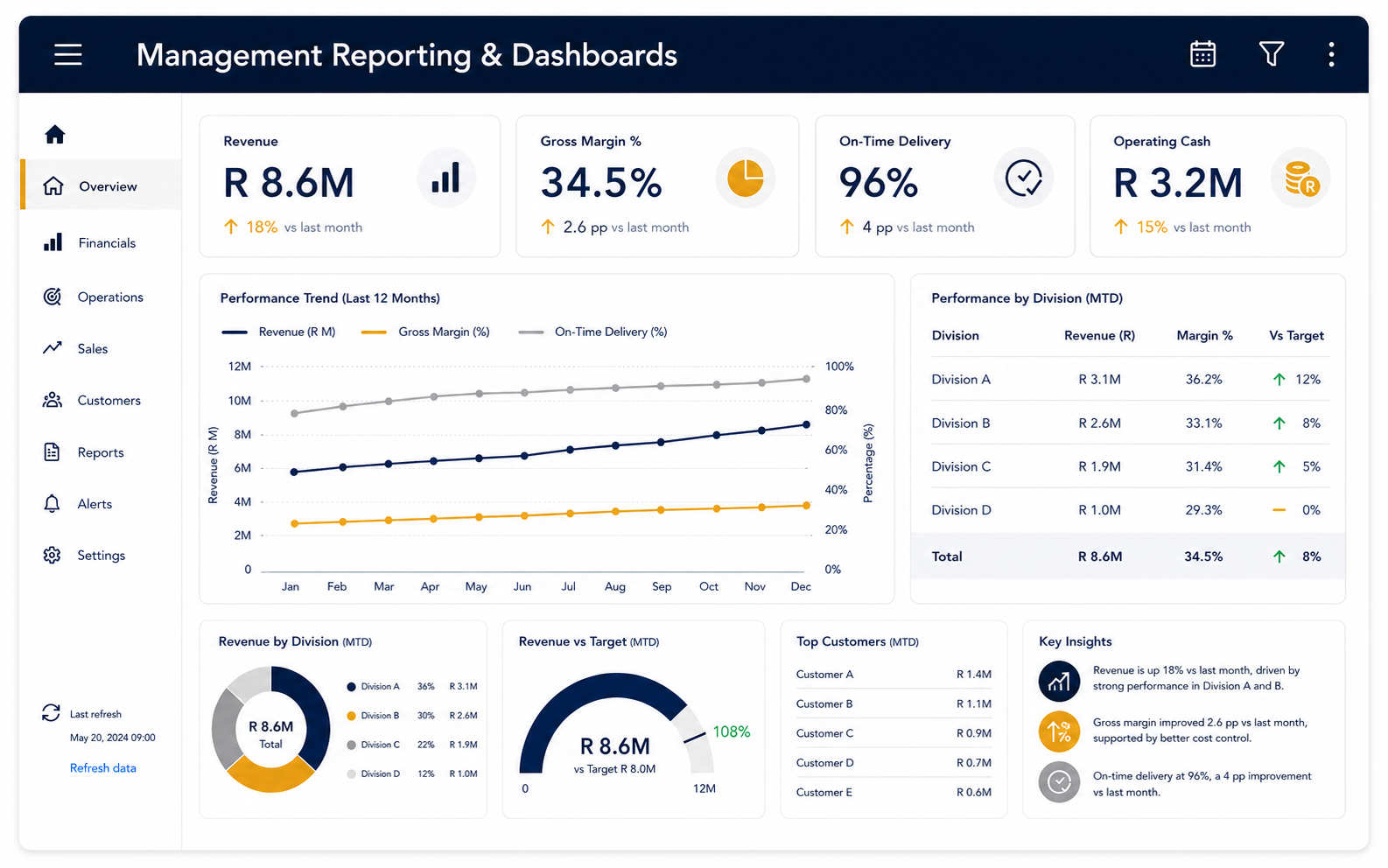
The result is a live view of your business, sales, production, stock, margin, that updates automatically and doesn't require anyone to compile a report. Your Monday morning looks different when you open one screen instead of six files.
The spreadsheets don't disappear. They get demoted. Instead of being the source of truth, they become input tools, which is the job they were always good at.