Most manufacturing business owners think they know their business. They know who their biggest customers are. They know which products sell the most. They know which sales rep is doing the work. But "biggest" and "most" aren't the same as "most profitable", and the gap between those two things is where your margin leaks.
Sales analysis is the work of connecting revenue to actual profit, by customer, product, and rep. It's often the first analysis we do with a new client, and it almost always produces at least one number that surprises the owner.
The revenue lies problem
Revenue is the most visible number in any manufacturing business, and the most misleading one when used alone. Your biggest revenue customer is often your most demanding customer. They negotiate hard on price. They require bespoke production runs. They call every week. They push for faster delivery. They issue credits and returns. By the time you account for all of that, their actual contribution to your margin can be a fraction of what the revenue figure suggests.
One of the most common findings in a first sales analysis: a customer in the top 3 by revenue who turns out to be barely profitable, or occasionally unprofitable, once service costs are factored in.
The same pattern applies to products. Your highest-volume product might require the most machine time, the most rework, and the most raw material per unit. Your lower-volume product might run efficiently and carry a 30% higher margin. Without the analysis, you're making sales and production decisions based on volume, not on what actually drives profitability.
In most manufacturing businesses, a small number of customers generate the majority of profitable revenue. Sales analysis tells you exactly who they are.
Product margin analysis
Product margin analysis answers a simple question: for every rand of revenue you earn on this product line, how much ends up as gross profit after direct costs?
The direct costs include: raw materials, direct labour, machine time, packaging, freight, and quality rework. Once you have the margin per product line, you can rank your products by profitability, not just volume, and make better decisions about:
- Where to focus your production capacity when it's constrained
- Which products to prioritise in your sales conversations
- Which product lines are worth growing and which are worth reviewing on pricing
- Where a price increase would have the least resistance but the biggest impact
Customer profitability analysis
Beyond product margin, customer profitability analysis adds the customer-specific costs, account management time, delivery frequency and cost, custom requirements, credit terms, returns, to give you a true profit-per-customer view.
This analysis typically produces a Pareto-style finding: a relatively small number of customers are generating most of your actual profit, while a tail of customers are absorbing significant time and cost for minimal return. Knowing this doesn't mean you drop those customers, but it does change how you talk to them at contract renewal and where you invest your growth effort.
Sales rep performance: activity vs results
Most sales analysis focuses on what each rep sold. Better sales analysis separates what they sold from what they sold profitably. A rep who sells high volumes at low margins by offering excessive discounts is costing you money, even if their revenue number looks great. Tracking margin per rep, not just revenue per rep, changes your incentive structure and your coaching conversations.
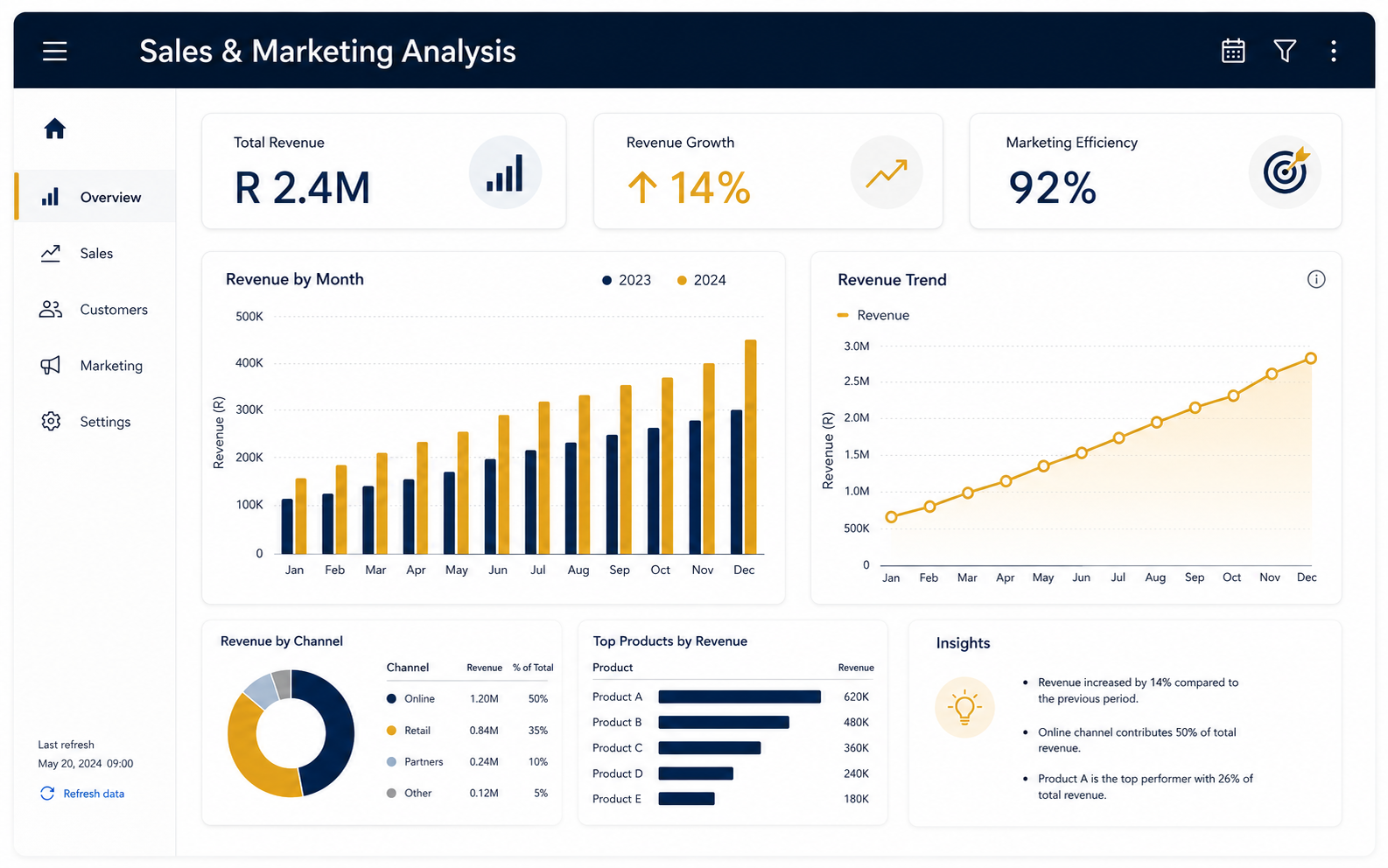
What a sales analysis dashboard looks like
A working sales analysis dashboard for a manufacturing business typically shows:
- Revenue vs margin by product line, ranked and trended over 12 months
- Top 10 customers by revenue, with margin % alongside
- Sales rep performance: revenue, margin, and number of active accounts
- Geographic or channel breakdown: which regions or channels are profitable
- Month-on-month trend for margin % across the business
It updates automatically each month as new sales data comes in. The owner looks at it on Monday morning and knows exactly which parts of the business are pulling their weight, and which aren't.